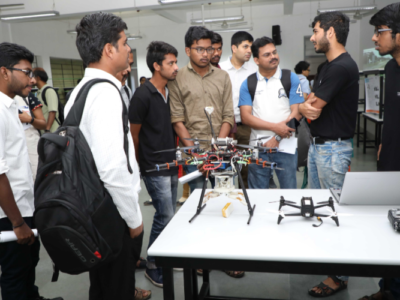
Coimbatore Institute of Technology, Coimbatore, Tamil Nadu
College Type: Autonomous
Total Tuition Fees: Rs. 5 L – 10 L
Courses Offered: 3 Courses
Exams Accepted: 3 Exams

The global energy sector is undergoing a massive transformation. Traditional electricity grids are being replaced by intelligent, automated, and digitally connected systems capable of managing modern energy demands efficiently. At the center of this transformation lies Smart Grid Technology, a rapidly growing specialization in electrical engineering that combines power systems, communication networks, automation, and digital monitoring to create more reliable and sustainable energy infrastructure.
An M.Tech in Electrical Engineering with Specialization in Smart Grid Technology is an advanced postgraduate program designed for students who want to build expertise in modern electrical networks, renewable energy integration, grid automation, and intelligent power distribution systems. As countries around the world move toward clean energy and digital power infrastructure, professionals trained in smart grid systems are becoming highly valuable across the energy sector.
This program equips students with both theoretical and practical knowledge of modern grid technologies, preparing them for careers in utilities, renewable energy companies, smart infrastructure firms, power system consulting, and research organizations.
Smart Grid Technology refers to the modernization of electrical power grids using digital communication, sensors, automation, and intelligent monitoring systems. Unlike traditional power grids, smart grids enable two-way communication between power providers and consumers, improving efficiency, reliability, and sustainability.
show more| Feature | Description |
|---|---|
| Real-Time Monitoring | Tracks power generation and consumption instantly |
| Automated Fault Detection | Identifies and isolates faults quickly |
| Renewable Integration | Supports solar, wind, and hybrid power systems |
| Demand Response | Adjusts power distribution based on usage patterns |
| Smart Metering | Enables accurate digital billing and monitoring |
| Self-Healing Networks | Automatically restores power during disturbances |
Smart grids are considered the future backbone of sustainable power infrastructure.
As governments and industries invest heavily in modernizing electrical infrastructure, demand for skilled smart grid engineers is growing rapidly.
Power utilities and energy companies are actively recruiting smart grid specialists for modernization projects.
The energy sector is shifting toward digital and automated systems, making smart grid expertise increasingly valuable.
Smart grids play a crucial role in connecting solar, wind, and battery storage systems.
Countries worldwide are adopting smart grid frameworks for energy efficiency and sustainability.
The field offers advanced scope in IoT-based energy systems, AI-powered grids, and grid cybersecurity.
| Particular | Details |
|---|---|
| Course Name | M.Tech Electrical Engineering (Smart Grid Technology) |
| Duration | 2 Years |
| Eligibility | B.Tech/BE in Electrical/Electrical & Electronics |
| Admission Process | Entrance Exam / Merit Based |
| Course Level | Postgraduate |
| Average Fees | ₹1,00,000 – ₹4,00,000 |
| Career Scope | Power Utilities, Renewable Energy, Grid Automation, Research |
Students seeking admission must fulfill the following requirements:
Students entering this specialization should ideally possess:
| Skill | Importance |
|---|---|
| Power System Fundamentals | Core understanding of electrical networks |
| Analytical Thinking | For grid optimization and fault analysis |
| Programming Knowledge | Helpful for automation and simulation tools |
| Data Interpretation | For monitoring and predictive analytics |
| Communication Skills | Required in project coordination |
| Research Aptitude | Useful in innovation and development |
The curriculum combines advanced electrical engineering with modern digital technologies.
| Subject | Focus Area |
|---|---|
| Advanced Power Systems | Grid planning and operation |
| Smart Grid Architecture | Intelligent grid framework design |
| Power Electronics | Converter and inverter technologies |
| Renewable Energy Systems | Solar/wind integration |
| Electrical Energy Storage | Battery and storage systems |
| Grid Communication Networks | Data transfer protocols |
| SCADA Systems | Supervisory control and automation |
| Smart Metering Technologies | Digital metering systems |
| Demand Side Management | Consumer load optimization |
| Cybersecurity for Power Systems | Protection against cyber threats |
Traditional grids are increasingly unable to meet modern energy challenges due to:
Smart grids address these issues through digital intelligence and automation.
Power disruptions can be detected and corrected quickly.
Real-time monitoring reduces wastage and transmission losses.
Facilitates smooth integration of distributed energy resources.
Consumers can monitor and manage electricity usage.
Automation minimizes manual intervention.
Practical learning is a major part of this specialization.
| Laboratory | Learning Outcomes |
|---|---|
| Power Systems Lab | Grid simulation and analysis |
| Smart Metering Lab | Meter installation and testing |
| SCADA Lab | Automation and remote monitoring |
| Renewable Integration Lab | Solar/wind grid connection |
| Power Electronics Lab | Converter design and testing |
| IoT & Automation Lab | Smart sensor applications |
Students also work on real-time simulation tools such as:
The smart grid domain is continuously evolving with integration of next-generation technologies.
AI helps predict demand, detect faults, and optimize load balancing.
IoT devices provide real-time monitoring of transformers, meters, and substations.
Peer-to-peer electricity trading systems are emerging.
Virtual models of grid infrastructure improve predictive maintenance.
Smart grids manage EV charging loads efficiently.
Graduates can find opportunities in:
| Sector | Recruiters |
|---|---|
| Government Utilities | NTPC, PGCIL, State Electricity Boards |
| Private Power Companies | Tata Power, Adani Electricity, Reliance Energy |
| Renewable Energy Firms | ReNew Power, Suzlon, Siemens Gamesa |
| Automation Companies | ABB, Siemens, Schneider Electric |
| Consulting Firms | Deloitte Energy, PwC Infrastructure |
| Research Organizations | CPRI, BHEL R&D, ISRO Energy Divisions |
Smart Grid Technology is one of the fastest-growing electrical engineering domains due to:
According to industry projections, demand for smart grid professionals will continue to rise significantly over the next decade.
After M.Tech, students may pursue:
Completing an M.Tech in Electrical Engineering with specialization in Smart Grid Technology opens doors to a wide range of career opportunities across the modern energy sector. As electrical infrastructure becomes more intelligent and interconnected, organizations are actively seeking professionals who understand digital grids, automation, renewable integration, and advanced power system management.
Graduates can work in power generation, transmission, distribution, renewable energy, industrial automation, consulting, and government infrastructure projects. Since smart grids combine electrical engineering with digital technology, the scope extends beyond traditional power sector roles.
| Job Role | Key Responsibilities |
|---|---|
| Smart Grid Engineer | Design and optimize intelligent power distribution systems |
| Power System Engineer | Analyze grid performance and improve reliability |
| Grid Automation Engineer | Implement automated monitoring and control systems |
| SCADA Engineer | Manage supervisory control and data acquisition systems |
| Renewable Integration Engineer | Connect solar/wind systems to smart grids |
| Energy Analyst | Monitor energy consumption and optimize efficiency |
| Protection Engineer | Design relay and protection schemes for grid safety |
| Substation Automation Engineer | Automate substations using intelligent electronic devices |
| Electrical Design Engineer | Develop electrical layouts for modern grid systems |
| Research Scientist | Innovate in advanced digital power technologies |
Government-owned power corporations require smart grid experts for grid modernization initiatives.
Common Recruiters
Private utilities are heavily investing in digital transformation.
Major Employers
Solar and wind developers need specialists to integrate distributed energy resources into the grid.
Top Recruiters
These companies design hardware/software for smart grid infrastructure.
Leading Firms
Compensation depends on employer, location, technical expertise, and project exposure.
| Experience Level | Average Salary Range |
|---|---|
| Entry Level | ₹4 LPA – ₹8 LPA |
| Mid-Level (3–5 Years) | ₹8 LPA – ₹15 LPA |
| Senior Level | ₹15 LPA – ₹25+ LPA |
| International Roles | Higher based on country/project |
Professionals with skills in grid simulation, SCADA, automation, and renewable integration often command premium salaries.
To secure high-growth roles, graduates should develop expertise in the following:
Smart grids are no longer limited to electricity boards. They are now used in multiple industries.
Digital substations and intelligent distribution systems improve reliability.
Integrated energy systems manage urban electricity demand efficiently.
Smart grids optimize EV charging and load distribution.
Factories use smart energy monitoring for operational efficiency.
Localized power systems improve resilience in campuses and remote areas.
Renewable energy sources such as solar and wind are variable in nature. Smart grids help manage this variability through intelligent forecasting and balancing systems.
| Smart Grid Function | Renewable Energy Benefit |
|---|---|
| Real-Time Monitoring | Tracks renewable generation instantly |
| Load Forecasting | Predicts demand-supply fluctuations |
| Storage Integration | Manages batteries and backup systems |
| Automated Dispatch | Optimizes energy routing |
| Demand Response | Balances consumption during peak load |
This makes smart grid engineers critical to the clean energy transition.
Many countries are investing in grid modernization due to:
International opportunities exist for professionals with strong technical and project experience.
Additional certifications can improve employability significantly.
| Certification | Benefit |
|---|---|
| Certified Energy Manager (CEM) | Energy optimization expertise |
| SCADA/PLC Certification | Automation specialization |
| ETAP Certification | Power system modeling skills |
| Renewable Energy Certification | Solar/wind integration knowledge |
| IoT Certification | Smart monitoring systems expertise |
Graduates interested in R&D can work in emerging areas such as:
Machine learning for predictive energy demand.
Peer-to-peer smart electricity transactions.
Protecting digital grid infrastructure.
Using EV batteries to support grid load.
Creating virtual power network models.
Smart grid specialists can start ventures in:
Government policies promoting clean energy make this a promising entrepreneurial field.
Because of these factors, Smart Grid Technology is expected to remain one of the most promising electrical engineering specializations.
Many reputed institutions offer M.Tech Electrical Engineering programs with Smart Grid Technology or related smart power system specializations. Choosing the right institution can significantly impact practical exposure, placement opportunities, and research prospects.
| College / Institution | Location | Key Highlights |
|---|---|---|
| Indian Institute of Technology Delhi | New Delhi | Advanced power systems and grid research labs |
| Indian Institute of Technology Bombay | Mumbai | Strong electrical engineering research ecosystem |
| Indian Institute of Technology Madras | Chennai | Focus on renewable and digital grid systems |
| National Institute of Technology Tiruchirappalli | Tiruchirappalli | Industry-linked electrical engineering curriculum |
| Vellore Institute of Technology | Vellore | Modern smart energy and automation labs |
| Manipal Institute of Technology | Manipal | Industry-oriented electrical specialization options |
Students should compare curriculum, faculty expertise, research labs, and placement support before applying.
Securing admission into a quality institution often requires careful preparation.
Most top colleges consider GATE scores for admission.
Focus on:
Knowledge of simulation tools strengthens your profile.
Undergraduate projects related to renewable energy, automation, or IoT can improve admission chances.
M.Tech students usually complete a dissertation/project in a specialized domain.
| Research Area | Description |
|---|---|
| Renewable Grid Integration | Managing solar/wind variability |
| Smart Meter Analytics | Consumer usage data analysis |
| Fault Detection Algorithms | AI-based outage identification |
| Grid Cybersecurity | Securing digital infrastructure |
| Battery Energy Storage Systems | Grid-scale storage optimization |
| EV Charging Optimization | Managing charging demand |
| Microgrid Control Systems | Localized smart power networks |
| Demand Response Systems | Intelligent consumption balancing |
These research areas are aligned with current industry and academic priorities.
Although smart grids offer many benefits, implementation involves significant challenges.
Digital infrastructure and automation equipment require substantial capital.
Connected grids are vulnerable to hacking and cyber threats.
Integration of multiple technologies demands multidisciplinary expertise.
Older grid systems require upgrades before modernization.
Policy and standardization frameworks are still evolving.
Understanding these challenges helps engineers design practical solutions.
The future of smart grids will be shaped by several transformative developments.
AI will automate forecasting, maintenance, and fault prediction.
Consumers will increasingly generate and sell their own electricity.
Electric vehicles will act as mobile energy storage systems.
Secure decentralized electricity trading will expand.
Faster communication will improve real-time grid responsiveness.
Numerous public initiatives are accelerating growth in this field.
These initiatives create long-term employment and research opportunities.
This specialization is particularly valuable for students interested in:
M.Tech Electrical in Smart Grid Technology is one of the most future-oriented postgraduate engineering specializations available today. As nations modernize electrical infrastructure and adopt renewable energy at scale, the demand for engineers capable of managing intelligent, digital, and sustainable power systems continues to rise.
The program offers a strong mix of electrical engineering fundamentals, digital technology, automation, and sustainability—preparing graduates for impactful roles in the evolving energy sector.
For students seeking a career at the intersection of power engineering and digital transformation, Smart Grid Technology presents outstanding long-term potential.
It is a postgraduate engineering program focused on modern digital power systems, intelligent grid automation, renewable energy integration, and advanced electrical network management.
The course duration is generally 2 years, divided into four semesters.
Common subjects include:
Smart Grid Architecture
Advanced Power Systems
Renewable Energy Integration
SCADA Systems
Power Electronics
Smart Metering Technologies
Grid Cybersecurity
Graduates can work as:
Smart Grid Engineer
Power System Engineer
SCADA Engineer
Renewable Integration Engineer
Grid Automation Specialist
Industries include:
Power Utilities
Renewable Energy Companies
Automation Firms
Smart City Projects
Research Organizations