
You have finished your BAMS. Now what? Many graduates ask this question. For example, some want to treat patients with more confidence. Others want to teach. Still others want to do research. The good news is that a postgraduate degree can open all three paths.
However, the choices can feel confusing. First, there are many subjects. Second, there is one big entrance test. Finally, counselling has several rounds. So, this guide explains md ayurveda courses in simple words. You will learn what the degrees mean, who can apply, how to pick a subject and what to do next.
This blog is for BAMS interns, fresh graduates and their families. Also, if you want more guides like this, visit BhavyaGyan for Ayurveda education updates.
What Are MD Ayurveda Courses?

MD Ayurveda is a three-year postgraduate degree. In fact, it is also called Ayurveda Vachaspati (MD). Because it builds deep knowledge in one subject, you study the classical texts, modern research methods and clinical practice together.
The course has three parts. First, you learn theory in class. Then, you practise in the hospital or lab. Finally, you write a dissertation, which is a research project on a topic from your subject.
MD vs MS in Ayurveda: What Is the Difference?
Similarly, both degrees are postgraduate and last three years. However, the main difference is the type of work.
- MD (Doctor of Medicine): Focuses on medicine, diagnosis, drug science and basic sciences. Most subjects fall here.
- MS (Master of Surgery): Focuses on surgical and para-surgical work. Therefore, it suits students who like procedures and hands-on care.
Neither degree is better. Instead, the right one depends on your interest and career goal.
Course Structure at a Glance
- Duration: 3 years
- Entry route: National entrance test followed by counselling
- Core parts: Classroom learning, clinical training, teaching practice and dissertation
- Regulator: The National Commission for Indian System of Medicine sets the rules for the course
Is an Ayurveda PG Degree Right for You?
A PG degree takes three years of hard work. However, it is worth it when you have a clear reason. So, ask yourself a few honest questions before you apply.
- Do I want to become a specialist instead of a general practitioner?
- Am I ready for long hours in the hospital, the lab and the library?
- Do I enjoy reading classical texts and linking them to modern practice?
- Do I see myself teaching or doing research in the future?
If most answers are yes, MD or MS can be a smart move. However, if you are unsure, talk to a mentor first. Also, working for a year in a clinic can give you a better picture of what you enjoy.
PG Ayurveda Eligibility: Who Can Apply?

Before you plan, check pg ayurveda eligibility carefully. Rules can change each year. Therefore, always confirm on the official notice. The basic points are given below.
Basic Qualification
You need a BAMS degree from a recognised institution. Also, the college and university should follow the national norms for Ayurveda education. Otherwise, a degree from an unrecognised college can block your admission later.
Internship Requirement
The compulsory rotatory internship is a key rule. For this reason, most candidates must complete it before they join the PG course. Interns often apply for the test. However, the internship must be done within the time set in the official notice. Finally, keep your internship certificate safe.
Entrance Exam: AIAPGET
Admission is based on a national entrance test called the All India AYUSH Post Graduate Entrance Test. It is conducted by the National Testing Agency. The exam is computer-based and uses multiple-choice questions. As a result, your score and rank decide your counselling chances.
Read the official information bulletin each year, because it lists the exam pattern, syllabus, fees and important dates. For structured revision, you can also check Bhavya Gyan Academy courses.
Documents to Keep Ready
- BAMS final mark sheets and degree or provisional certificate
- Internship completion certificate
- Also, registration proof with the state Ayurveda council, if asked
- Identity proof and passport-size photos
- Lastly, category or domicile certificates, if you claim any quota
MD Ayurveda Specializations You Can Choose
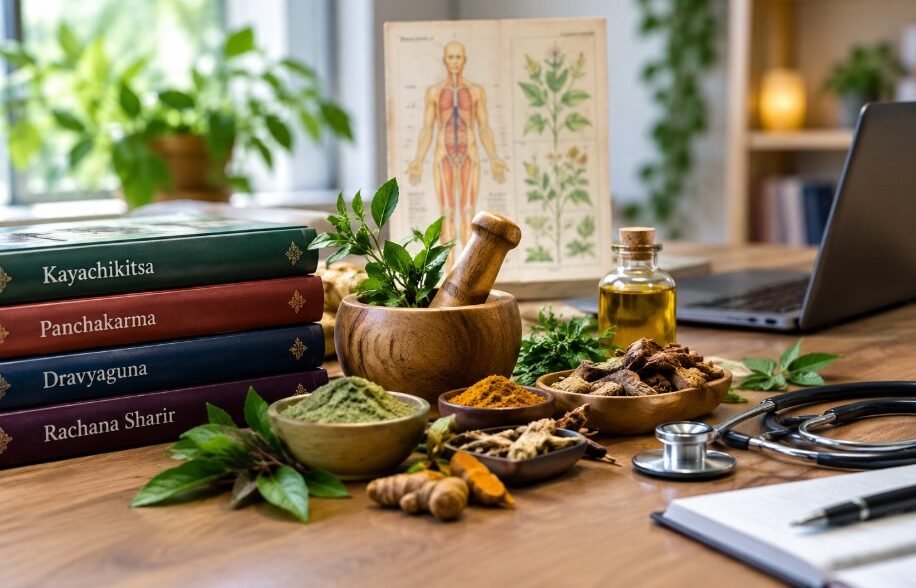
In fact, choosing a subject is the biggest decision in your PG journey. The list below groups the popular ayurveda postgraduate options so it is easier to compare. However, subject names and seats can differ by year and college. Therefore, check the latest list before you decide.
Clinical Specializations
These suit students who want to treat patients and build a practice.
- Kayachikitsa: General medicine in Ayurveda. It covers long-term and lifestyle diseases. It is one of the most sought-after subjects.
- Panchakarma: Detox and therapy procedures. It is popular in wellness centres and hospitals.
- Kaumarbhritya: Child health and paediatrics in Ayurveda.
- Manasa Roga: Mental health from an Ayurveda view.
- Roga Nidana and Vikriti Vigyan: Diagnosis and disease pathology.
Drug Science Specializations
These suit students who like herbs, formulations and product work.
- Dravyaguna: Study of medicinal plants and their actions.
- Rasashastra and Bhaishajya Kalpana: Making and testing Ayurveda medicines.
- Agad Tantra: Toxicology and forensic medicine in Ayurveda.
Basic Science and Principle Specializations
These suit students who enjoy teaching and research.
- Rachana Sharir: Anatomy.
- Kriya Sharir: Physiology.
- Samhita and Siddhanta: Classical texts and core principles.
- Swasthavritta and Yoga: Preventive health, lifestyle and yoga.
MS Ayurveda Specializations Explained
In contrast, the ms ayurveda specializations are fewer. They focus on surgical and specialty care.
- Shalya Tantra: General surgery. It includes Kshara Sutra and other para-surgical methods. It is used for conditions like piles and fistula.
- Shalakya Tantra: Diseases of the eye, ear, nose, throat, head and mouth.
- Prasuti Tantra and Stri Roga: Obstetrics and women’s health.
So, if you enjoy procedures and patient care, MS can be a strong fit. As a result, many MS graduates build busy specialty clinics.
How to Choose the Right Specialization

Instead of choosing a subject only because of rank or trend, use this simple method.
- List your interests. Think about what you enjoyed most in BAMS and internship.
- Pick a career goal. Do you want a clinic, a teaching job, research or a product business?
- Check seat availability. Look at past counselling data for seats in each subject.
- Talk to seniors. Also, ask current PG students about workload and hospital exposure. Reading Ayurveda career guidance can add more ideas.
- Compare colleges. However, the same subject can feel very different in two colleges.
In addition, make a backup list. Rank alone may not get your first choice. Therefore, a flexible plan saves time during counselling.
MD Ayurveda Admission Process: Step by Step
- Watch for the notice. The exam agency publishes dates and the information bulletin on its website.
- Register and apply online. Fill in the form and upload the documents.
- Prepare for the test. Revise BAMS subjects with a clear plan and take mock tests. For example, a guided programme such as Bhavya Gyan Academy can help you stay consistent.
- Appear for the exam. Reach the centre early and carry your admit card.
- Register for counselling. Seats are filled through central and state counselling rounds.
- Choose and lock your options. Fill your college and subject choices carefully.
- Report to the college. Submit original documents and pay the fees on time.
Deadlines in counselling are strict. Because a missed date can cost you a seat, keep digital and printed copies of every document.
Prepare for the Entrance Test?
Build a study plan, practise mock tests and stay consistent until counselling day.
How to Choose a Good PG Ayurveda College

A good college shapes your skills for life. First, check these points before you fill your choices.
- Recognition: The college must be approved by the national commission.
- Faculty: Look for experienced teachers in your chosen subject.
- Hospital load: More patients mean more clinical learning.
- Labs and library: Research needs good facilities and journal access.
- Research culture: Ask how many dissertations reach publication.
- Fees and hostel: Compare the total cost instead of only the tuition. The college guides on Mantech Publications can help you understand what to look for.
If you can, visit the campus. Then, speak to students. Finally, ask for the last three years of results and placement details. Career planning support from a guidance partner like BGC Global can also make the comparison easier.
Plan Your Budget Early
Fees differ between government, private and deemed institutions. Besides tuition, plan for hostel, books, exam fees, dissertation costs and counselling deposits. Ask each college for a written fee structure. For fee and admission guidance, BGC Global admission support can also help. In addition, ask about stipends, because some institutions provide them. As a result, a clear budget helps you avoid stress in the middle of the course.
Need Help Comparing Colleges?
Get guidance on admissions, college shortlisting and career planning before you lock your choices.
Career Scope After MD or MS Ayurveda

In fact, a PG degree gives you more than a title. It gives you focus and credibility. Here are the main paths.
Clinical Practice
You can start your own clinic or join a hospital as a consultant. For example, specialists in Panchakarma, Kayachikitsa and Shalya Tantra are in demand in wellness and treatment centres.
Teaching
A PG degree is usually needed to become a lecturer in an Ayurveda college. Read more education guides to understand how college teaching works. Moreover, teachers guide interns and PG scholars. In addition, publications add weight to your teaching profile.
Research
You can work on clinical trials, drug standardisation and safety studies. Bodies like the Central Council for Research in Ayurvedic Sciences run research programmes in this field.
Government and Public Health
Ayush departments, hospitals and public health programmes hire PG-qualified doctors. Check the Ministry of Ayush website for schemes and notices.
Pharma and Wellness Business
Drug science graduates can work in Ayurveda manufacturing, quality control and product development. Meanwhile, others build wellness retreats, online consultation brands and health-education platforms.
Why Research and Publishing Matter in Your PG Journey

Above all, your dissertation is more than a course requirement. It is your first serious research work. A well-written paper can support your teaching career and your professional name.
Start With Good Reading
First, search past studies on PubMed before you choose a topic. For example, many scholars publish in indexed journals. To see what journals in health and medicine look like, browse the medical science journals listed by Mantech Publications. Drug science students can also explore the pharmacy journals for herb and formulation studies. Thus, reading them will show you how strong papers are structured.
In addition, open-access journals listed in the Directory of Open Access Journals let you read full papers for free.
Prepare and Submit Your Paper
Next, when your dissertation is ready, follow the paper submission guidelines of your chosen journal. This matters because formatting mistakes cause many rejections. Additionally, if you need help with structure or language, research paper assistance services can guide you through the process. Furthermore, you can learn how paper publication works from start to finish.
When you are ready, you can submit your manuscript online. Also, read the benefits for authors to see what support you get. After acceptance, DOI and metadata services help readers find and cite your work.
Go Beyond the Dissertation
Later in your career, you may want to write an Ayurveda textbook or a clinical guide. In that case, book writing and publishing support can help you plan the manuscript. Meanwhile, the education guides, research articles and career articles on Mantech Publications are a useful read.
Publish Your Dissertation?
Turn your PG research into a published paper. Get help with journals, submission, DOI and author support.
Common Mistakes to Avoid
- Ignoring the official notice. Rules and dates change, so always read the source.
- Choosing a subject by trend. Interest, however, keeps you strong for three years.
- Skipping college research. After all, a big name does not always mean strong training.
- Starting late. Therefore, begin your exam plan early, ideally during internship.
- Missing documents. So, prepare files well before counselling starts.
- Leaving research for the last month. Instead, pick your dissertation topic early and collect data steadily.
- Relying on one source. Instead, cross-check dates and rules on official websites, not only on social media groups.
Avoiding these mistakes will not make the journey easy. However, it will make the journey smoother. As a result, you can stay focused on learning instead of last-minute fixes.
Conclusion
MD and MS in Ayurveda can shape a strong career in practice, teaching or research. First, start with the basics: eligibility, entrance exam and subject choice. Next, compare colleges and plan your counselling. Finally, remember that small steps taken early make a big difference.
Ready to Take the Next Step?
Compare subjects, understand eligibility and plan your PG journey with clear guidance.
External Resources
FAQs:
No. MD Ayurveda admission uses AIAPGET, the national AYUSH postgraduate entrance test, not NEET PG.
Often yes. However, you must finish internship within the deadline in the official notice.
Both are three-year postgraduate courses. Moreover, they include theory, clinical training and a dissertation.
No single winner exists. Kayachikitsa, Panchakarma and Shalya Tantra are popular. However, interest and location matter more than trends.
Yes. They can join clinical research, drug studies, teaching and government research institutes.
- National Testing Agency: Exam notices and information bulletins
- Ministry of Ayush, Government of India: Policies, schemes and updates
- Central Council for Research in Ayurvedic Sciences: Research programmes in Ayurveda
- Ayush Admissions Central Counselling Committee: Central counselling for AYUSH seats
- PubMed: Search past studies for your dissertation topic
- Directory of Open Access Journals: Free, open-access journals
Comments