
Every year, thousands of pharmacy graduates in India look beyond the domestic job market. Gulf hospitals, retail pharmacy chains, and pharmaceutical companies are hiring Indian pharmacists in large numbers. If you hold a D.Pharm, B.Pharm, M.Pharm, or Pharm.D degree, abroad pharmacy jobs for Indian graduates can offer better pay, faster career growth, and global work exposure.
This guide explains where the openings are, how licensing works, what visas you need, and how to avoid common mistakes. Read till the end for a clear, step-by-step action plan.
Why Indian Pharmacy Graduates Are in Demand Abroad

Gulf countries are expanding their private and government hospitals fast. Saudi Arabia’s Vision 2030 plan alone is adding thousands of healthcare jobs every year. The UAE, Qatar, Oman, Kuwait, and Bahrain are following a similar pattern.
These countries do not have enough local pharmacists to fill every post, so they actively hire trained pharmacists from India, the Philippines, and Pakistan. Indian pharmacy graduates are preferred for a few clear reasons:
- Indian pharmacy education follows a structured, Pharmacy Council of India–approved curriculum
- English is the medium of instruction, so language is rarely a barrier
- Indian pharmacists already have strong drug knowledge and dispensing discipline
- Salaries abroad are tax-free in most Gulf countries
If you are still comparing career paths, first understand how pharmacy jobs in India work today. Both the domestic and abroad paths start with the same degree — what changes is licensing, salary, and lifestyle.
Top Countries Hiring Indian Pharmacists
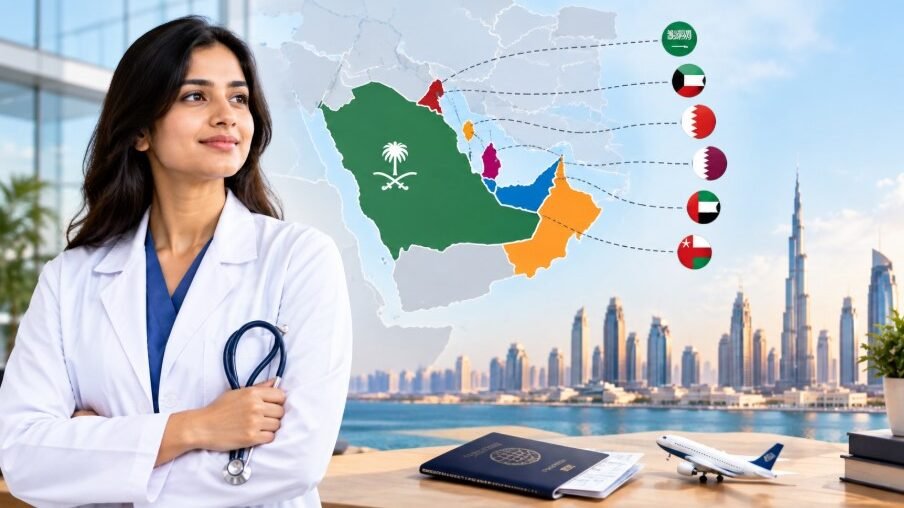
Saudi Arabia
Saudi Arabia hires pharmacists through the Saudi Commission for Health Specialties (SCFHS). You need to pass the Saudi Pharmacist Licensure Examination (SPLE), delivered through Prometric test centres in India and abroad. Only B.Pharm, M.Pharm, and Pharm.D degree holders are generally accepted for full pharmacist classification; D.Pharm alone is usually not eligible.
United Arab Emirates (Dubai, Abu Dhabi, Sharjah)
The UAE has more than one licensing body depending on the emirate: Dubai Health Authority (DHA), Department of Health Abu Dhabi (DOH), and the Ministry of Health and Prevention (MOHAP) for other emirates. All of them require DataFlow primary source verification and a Prometric exam, and most ask for at least two years of post-qualification pharmacy experience.
Qatar, Kuwait, Oman, and Bahrain
These countries follow a similar pattern: primary source verification of your degree, a licensing exam, and then a work visa tied to a hospital or pharmacy employer. Experience cutoffs and document requirements vary slightly by country, so always check the latest notification before you apply.
Beyond the Gulf
The UK, Canada, Australia, and the US also hire pharmacists, but the path is longer. It usually needs a separate equivalency exam, such as the GPhC assessment in the UK or FPGEE/NAPLEX-linked routes in the US, plus supervised practice hours. Most first-time applicants find Gulf countries faster to enter and easier to qualify for.
Which Pharmacy Degree Qualifies You for Jobs Abroad
Your eligibility abroad depends heavily on which pharmacy course you completed.
- D.Pharm holders can usually work in retail pharmacy support roles in India, but most Gulf licensing bodies do not accept D.Pharm alone for a full pharmacist license abroad
- B.Pharm graduates meet the minimum degree requirement for almost every Gulf licensing exam
- M.Pharm and Pharm.D graduates have an edge for hospital pharmacist, clinical pharmacist, and senior roles
If you have not finalised your degree path yet, compare D.Pharm vs B.Pharm before choosing, or go through the complete B.Pharm course details and M.Pharm specialisations to plan your degree around your abroad goals.
Step-by-Step Pharmacy Licensing Process Abroad

Every Gulf country follows roughly the same five-step licensing process.
Step 1: Register With Your State Pharmacy Council
Before you can work anywhere, you need an active pharmacist registration with your State Pharmacy Council in India. Keep it valid and renewed — an expired registration can stall your entire application abroad.
Step 2: Primary Source Verification (DataFlow)
DataFlow Group verifies your degree, mark sheets, licence, and experience letters directly with the issuing university, board, and employer. This step usually takes four to eight weeks and must be completed before you can book a licensing exam.
Step 3: Pass the Licensing Exam
Depending on your target country, you will sit for the SPLE (Saudi Arabia), the DHA, DOH, or MOHAP exam (UAE), or the equivalent Prometric-based test for Qatar, Kuwait, Oman, or Bahrain. These exams generally cover pharmacology, therapeutics, pharmacy calculations, and local pharmacy law.
Step 4: Receive Your Eligibility Letter
Once you pass, the licensing authority issues an eligibility or scheduling letter. This is usually valid for a limited window, so start job hunting and visa processing quickly once you receive it.
Step 5: Secure a Job Offer and Activate Your Licence
Your employer usually completes the final licence activation once you have a signed offer. Only after this can you legally start practising as a pharmacist in that country.
Pharmacist Visa Process for Gulf Countries

Once you have a job offer, your employer typically sponsors your work visa. The general visa flow looks like this:
- Employer applies for your work permit and entry visa
- You complete a medical fitness test in India or on arrival
- Your documents, including your licensing eligibility letter, are submitted to immigration
- You receive your entry visa and travel to the country
- After arrival, your employer processes your residence visa and labour card
Processing time varies from a few weeks to a couple of months depending on the country and how ready your documents are. Keep your passport valid for at least a year, and keep scanned copies of every certificate ready in advance.
Salary and Career Growth Abroad vs India
Pharmacist salaries in Gulf countries are usually tax-free and noticeably higher than typical starting salaries in India. Actual pay depends on your degree, experience, country, and employer type — government hospitals often pay more than small retail pharmacies.
Career growth abroad can also move faster. A pharmacist who starts in a community pharmacy can move into hospital pharmacy, clinical pharmacy, or even a pharmacy supervisor role within a few years of steady experience.
To see how this compares with staying in India, read our detailed breakdown of salary and career growth in pharmacy, check which roles pay the most through our guide to government pharmacy jobs, and explore the full range of pharmacy job roles open to graduates today.
Skills and Certifications That Boost Your Selection
Recruiters abroad look beyond your degree. A few things that consistently improve your chances:
- Clinical pharmacy or hospital pharmacy internship experience
- Basic working knowledge of hospital software and inventory systems
- Strong communication skills in English
- Awareness of current pharmaceutical research and drug updates
If you are aiming for an M.Pharm or a research-linked career path, staying current with peer-reviewed pharmacy research — such as the studies published in Mantech Publications’ Pharmacy Journals — can sharpen your subject knowledge and support a future academic or R&D path alongside clinical practice abroad.
You can also strengthen your resume with an online pharmacy course in clinical pharmacy or pharmacovigilance while your licensing documents are being processed.
Documents Checklist Before You Apply
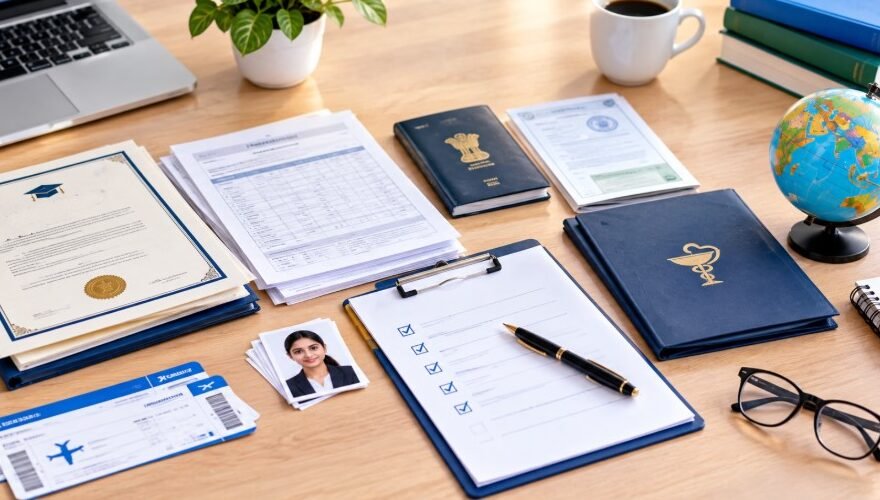
Keep these documents ready and scanned in advance — most delays happen because of missing paperwork, not because of exam difficulty.
- Degree certificate and all semester mark sheets
- State Pharmacy Council registration certificate (active, not expired)
- Experience letters from every employer, on letterhead, with exact dates
- Passport with at least 12 months of validity
- Passport-size photographs as per the destination country’s format
- Good Standing Certificate from your State Pharmacy Council, if you already have work experience
Common Mistakes to Avoid
- Applying for a country’s exam without checking your degree eligibility first
- Letting your Indian pharmacy council registration lapse
- Ignoring the required years of post-qualification experience
- Sending incomplete or mismatched documents for DataFlow verification, which restarts the timeline
- Choosing a pharmacy college without checking its accreditation and record-keeping quality
Why the Right College Matters Before You Go Abroad
If you are still in college or planning your pharmacy degree, the institution you choose matters more than most students realise. Strong accreditation adds credibility to your degree during document verification abroad, since DataFlow contacts your university and board directly to confirm your records.
Consultancies such as Bhavya Gyan Consultants (BGC) work directly with colleges on NAAC accreditation readiness. This indirectly benefits students too, because well-accredited institutions tend to maintain cleaner academic records, transcripts, and verification files — exactly what gets checked during your DataFlow process.
Before you enrol, compare a few top pharmacy colleges in India and confirm their accreditation status and placement record.
Conclusion
Abroad pharmacy jobs for Indian graduates open a real path to better pay, faster growth, and global work experience. But the process is document-heavy and time-bound. Start early: keep your pharmacy council registration active, prepare your DataFlow documents well in advance, and choose your target country based on your degree and experience level. Once you’re ready, explore live openings and speak to the right people before you apply.
FAQs:
Rarely as full pharmacists; most Gulf licences need B.Pharm, M.Pharm, or Pharm.D.
Usually four to eight weeks, depending on document accuracy.
Yes, most countries require at least two years of post-qualification experience.
Many applicants find the UAE’s DHA process comparatively simpler and faster.
Yes, most Gulf countries do not deduct income tax from salaries.
Yes, keep it active; an expired registration can delay verification abroad.
Yes, Prometric has test centres in several Indian cities for most Gulf exams.
Yes, it helps for hospital, clinical, and senior pharmacist roles specifically.
External Resources
- Pharmacy Council of India (PCI)
- Saudi Commission for Health Specialties (SCFHS)
- Dubai Health Authority (DHA)
- DataFlow Group — Primary Source Verification
- Prometric — Exam Scheduling
Comments