
Every hospital and diagnostic centre needs someone who can operate X-ray, CT, and MRI machines safely and accurately. That person is a radiology technician, and the radiology technician course you choose determines how quickly you enter this field and how far you can grow in it. With diagnostic imaging demand rising across both metro and Tier-2 cities, this is one of the more stable paramedical careers to build right now.
This guide compares the certificate, diploma, and degree routes into radiology technology, covers eligibility for each, and lays out the real career scope waiting on the other side. If you’re ready for the full B.Sc breakdown, BhavyaGyan’s B.Sc Radiology & Imaging Technology guide covers that path in detail.
What Does a Radiology Technician Actually Do?
A radiology technician operates diagnostic imaging equipment — X-ray, CT scan, MRI, and sometimes ultrasound — to help doctors diagnose illness and injury. The role involves positioning patients correctly, calculating safe radiation exposure, maintaining equipment, and working closely with radiologists to produce clear, usable scans.
It’s a hands-on, technical career that sits at the intersection of healthcare and equipment operation, which is exactly why the right course matters so much — you’re training for both patient safety and technical precision. A small positioning error or an unsafe radiation dose isn’t just a technical mistake; it directly affects a patient’s diagnosis and safety.

Radiology Technician Course Levels: Which One Fits You?
Certificate Courses (Fastest Entry)
Certificate programs, often 6 months to a year, offer the quickest path into entry-level radiology support roles. They suit students who want to start earning sooner and don’t mind a narrower initial scope, though promotion into senior or specialised roles usually takes longer without further study.
Diploma in Radiology / X-Ray Technician Course
A diploma, commonly called DMRIT (Diploma in Medical Radiology & Imaging Technology), typically runs 2 to 3 years and offers a stronger technical foundation than a certificate. This is the classic x ray technician course path many students search for, and it balances speed with a genuinely useful depth of clinical training. BhavyaGyan’s Diploma in Paramedical guide covers this route alongside other diploma-level paramedical options.
B.Sc Radiology & Imaging Technology (Degree Path)
A 3 to 3.5-year B.Sc gives you the deepest theoretical and clinical training, and generally opens higher starting salaries and senior roles faster than a diploma. It also keeps postgraduate study, such as an M.Sc in Medical Imaging, genuinely open later. For full eligibility, subjects, and semester-wise structure, see BhavyaGyan’s B.Sc Radiology & Imaging Technology guide.
Radiology Technician Course Eligibility
| Course Level | Duration | Minimum Eligibility |
| Certificate | 6 months – 1 year | 10+2 in any stream (Science preferred) |
| Diploma (DMRIT) | 2-3 years | 10+2 with Physics, Chemistry, Biology, 45-50% |
| B.Sc Radiology | 3-3.5 years | 10+2 with PCB, 50-60% aggregate |
Some colleges also require an entrance exam or interview, especially for B.Sc programs at government institutions, so always confirm the specific admission process for your shortlisted college.
Not sure which course level matches your goals and budget?
X-Ray Technician Course: A Closer Look
If you specifically want the fastest, most focused route into X-ray operation rather than broader imaging technology, a dedicated X-ray or diploma-level course is usually the right fit. It covers radiographic positioning, basic radiation safety, film and digital processing, and equipment handling, without the additional depth on CT, MRI, and nuclear medicine that a full B.Sc includes. Many technicians start here and later upgrade to a B.Sc through lateral entry or bridge programs once they’ve gained clinical experience.
Radiology Technology Course in India: Syllabus Overview
Across course levels, the core subject areas remain fairly consistent, just taught at different depths and with more clinical hours as you move from certificate to degree level:
- Human anatomy and physiology
- Radiographic and imaging techniques
- Radiation physics and safety protocols
- CT, MRI, and ultrasound imaging (deeper in diploma and degree programs)
- Patient care and positioning
- Clinical internship and hands-on training
The clinical internship component matters more than most students realise — it’s where you actually build the hands-on confidence that hospitals look for when hiring freshers. A program that treats internship as a formality rather than genuine supervised practice will leave you underprepared on your first job.
Radiology Tech Career Scope: Where You Can Work
Once qualified, radiology technicians find roles across a wide range of healthcare settings. BhavyaGyan’s Radiology & Imaging Jobs guide breaks down specific roles like CT technologist, MRI technologist, and ultrasound technician in detail. In broad terms, the sectors look like this:
| Sector | Typical Roles | Notes |
| Government hospitals | Radiographer, Imaging Technician | Stable, structured growth via seniority |
| Private hospitals & chains | CT/MRI Technologist, Senior Radiographer | Faster growth, higher metro-city demand |
| Diagnostic centres & labs | Imaging Technician, Shift Supervisor | High volume of routine scans |
| Abroad | Radiographer, Imaging Specialist | Requires local licensing and certification |
Government roles are also worth checking specifically — BhavyaGyan’s Government Paramedical Jobs guide covers eligibility and recruitment routes for radiography roles in the public sector.
Want to see specific radiology job roles and starting salaries?
Radiology Technician Salary in India: What to Expect
Salary depends heavily on course level, sector, and city. As a rough guide:
- Certificate/diploma holders, entry-level: roughly Rs. 15,000-25,000 per month
- B.Sc graduates, entry-level: roughly Rs. 20,000-35,000 per month
- Mid-level technologists (CT/MRI specialisation): roughly Rs. 35,000-55,000 per month
- Senior technologists / department leads: Rs. 55,000 and above
These figures are indicative and vary by employer, city, and specialisation, so treat them as a starting benchmark rather than a guarantee.
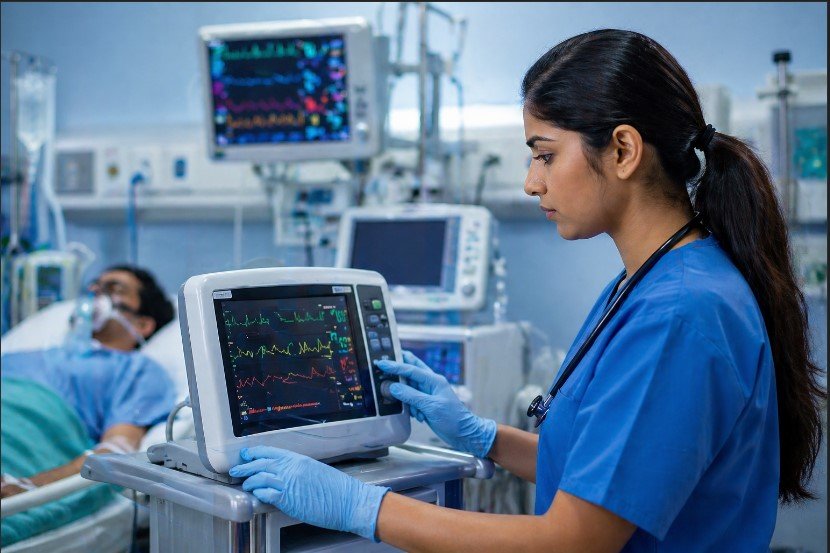
Choosing the Right College for Your Radiology Technician Course
Clinical exposure and equipment access matter more here than almost any other paramedical field, since you’re training to operate expensive, safety-critical machines. A college with outdated or limited equipment can leave you technically underprepared, no matter how good the classroom teaching is.
Check Institutional Accreditation
Many radiology technology programs run through universities that go through NAAC assessment. If you want to understand what that accreditation actually verifies before shortlisting a college, Bhavya Gyan Consultants’ overview of NAAC accreditation explains it clearly and simply.
Look for Genuine Clinical Training Access
A college with a functioning hospital or diagnostic centre tie-up gives you real machine-time, not just classroom theory. Ask specifically how many hours of hands-on imaging practice the program includes before you enrol, and whether that time is on modern or outdated equipment.
Comparing paramedical course options beyond radiology?
Radiology technicians and technologists interested in academic or research directions later in their career can also explore peer-reviewed health and allied-science journals from Mantech Publications as a credible outlet for published work.
Conclusion
There’s no single “best” radiology technician course — the right choice depends on how fast you want to enter the workforce versus how far you want to climb. Certificates get you working sooner; a diploma balances speed and depth; a B.Sc opens the widest long-term scope. Whichever level you choose, prioritise genuine clinical training access and a recognised, accredited institution over just proximity or fees.
FAQs:
A certificate or diploma (DMRIT) course, usually 6 months to 3 years.
10+2 with Physics, Chemistry, Biology, and 50-60% aggregate marks.
Degree offers higher pay and faster growth; diploma offers quicker entry.
Roughly Rs. 15,000-35,000 for freshers, rising with specialisation and experience.
Yes, many institutes offer lateral entry or bridge programs for diploma holders.
External Resources
- National Commission for Allied and Healthcare Professions (NCAHP)
- Atomic Energy Regulatory Board (AERB) — Radiation Safety
- Indian Radiological and Imaging Association (IRIA)
- Mantech Publications — Health & Allied Science Journals
Comments
[…] you are managing family assets or dealing with real estate inherited from parents, explore our dedicated Money/Property & Law pillar for in-depth insights into power of attorney and title deed […]